
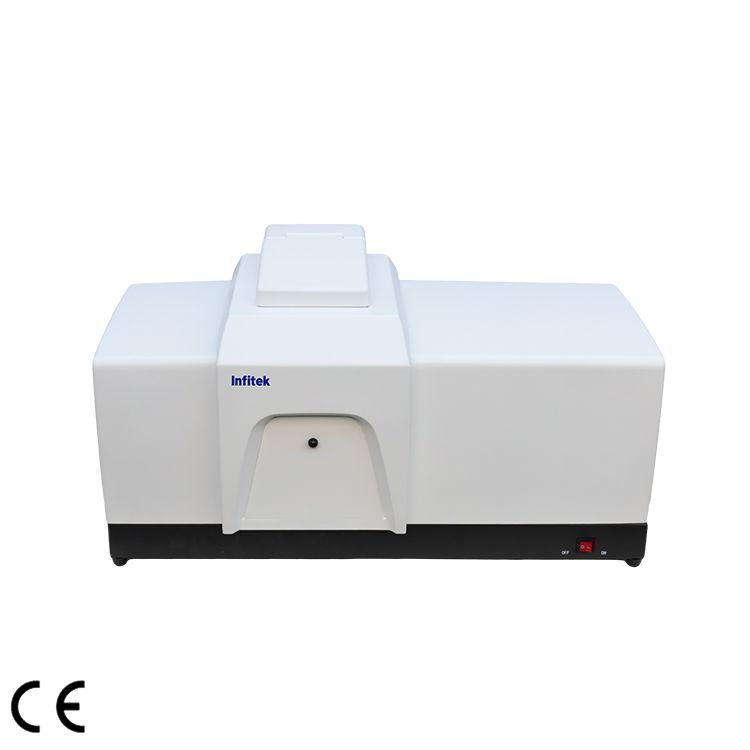
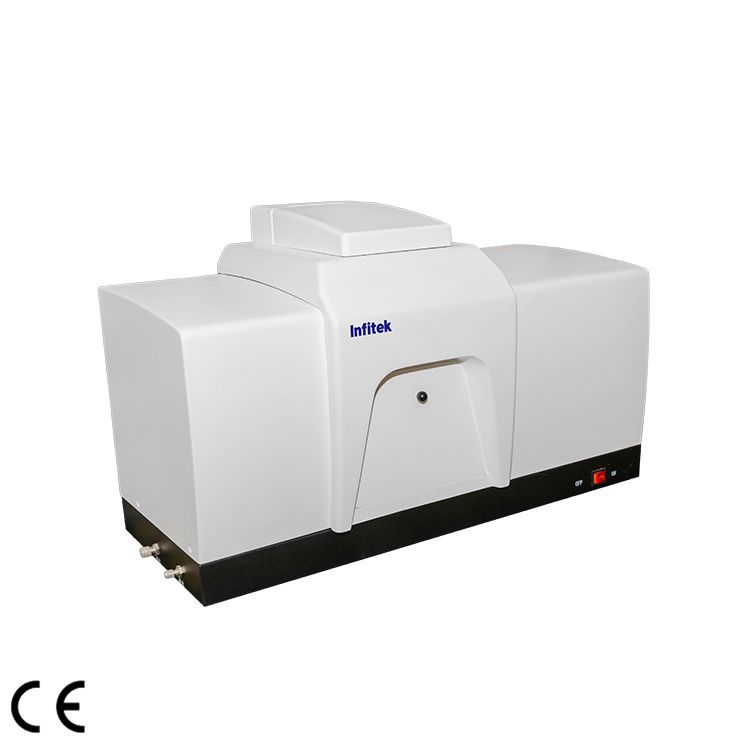
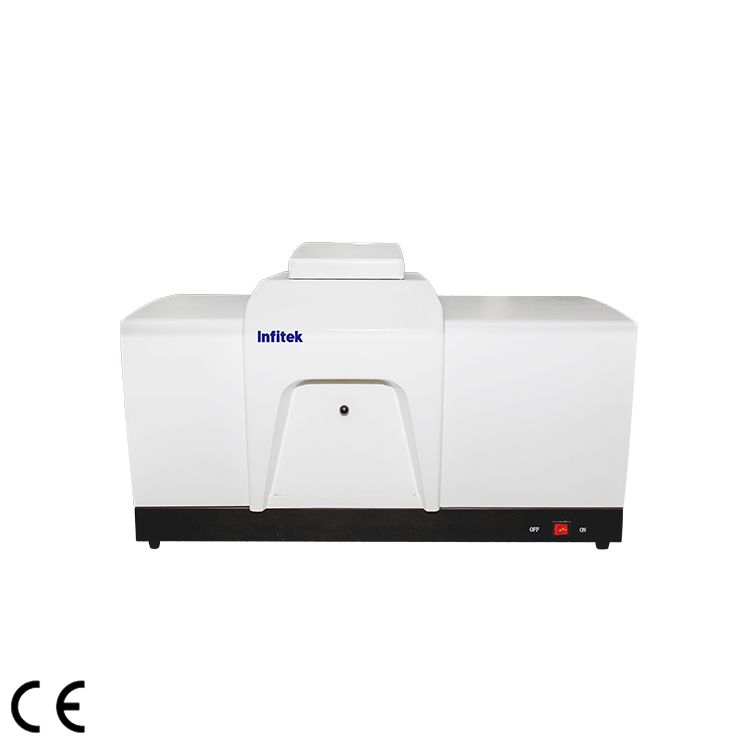
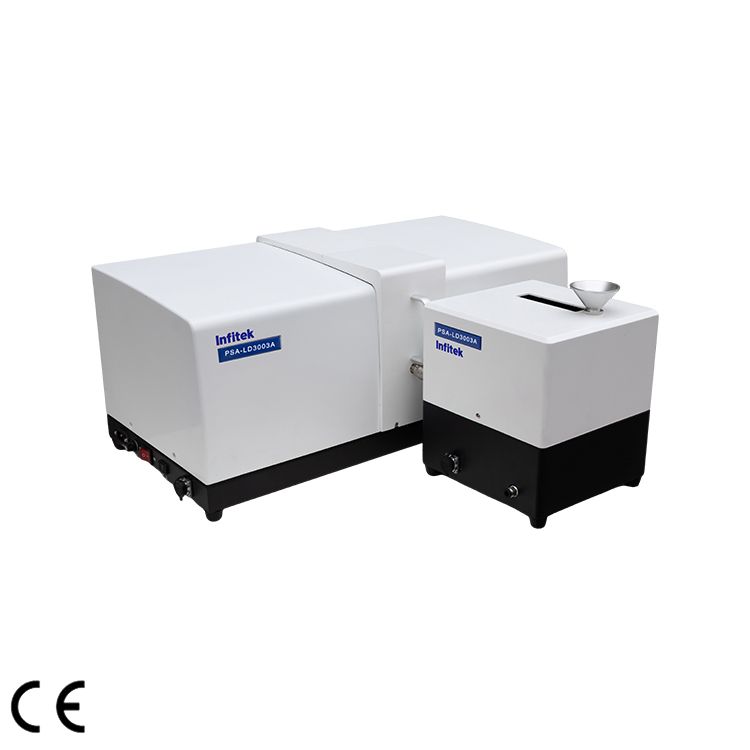
- User-Friendly Operation, Manual and Automatic Modes
- Convergent-light Fourier transform optical path technology
- Automatic Optical Path Alignment System
- Practical Sample Dispersion System
- Audit trail is optional to comply with 21 CFR Part 11
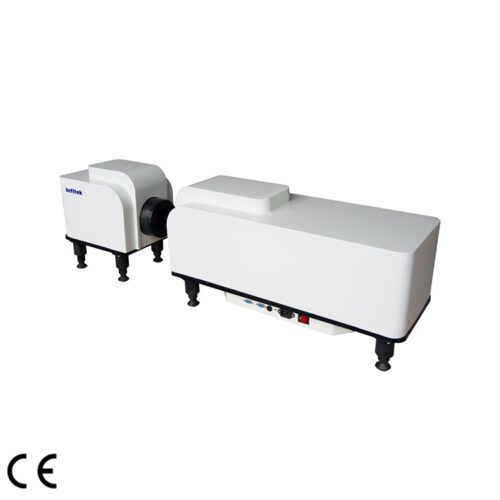
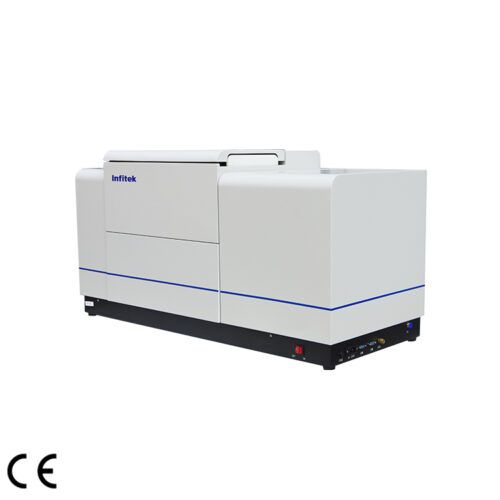
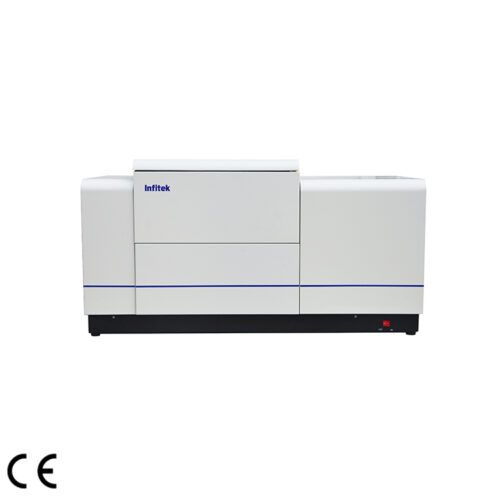
Laser Particle Size Analyzer, Practical Series
Beschreibung
The practical series laser particle size analyzer adopts the laser diffraction particle size measurement principle, combined with a highly sensitive annular photoelectric detector, significantly improving test precision. Its unconstrained free fitting technology truly reflects the particle size distribution, guaranteeing the authenticity and accuracy of test results. It is particularly suitable for testing materials with a narrow particle size distribution.
Features
User-Friendly Operation
Both manual and automatic modes are available for flexible selection based on sample characteristics. In specific scenarios (e.g., samples with unknown properties or tests requiring special parameters), users can first conduct a preliminary test in manual mode. After clarifying the sample features and optimal test conditions, formal testing can be performed in automatic mode for efficiency.
Rapid Measurement
Wet dispersion: When set to automatic mode, all operational procedures are executed automatically, including automatic water supply, ultrasonic sample dispersion, stirring, circulation, background calibration, sample testing, data analysis, drainage and cleaning. This dramatically shortens the measurement cycle, with the entire process taking less than 2 minutes.
Dry dispersion: The intelligent operation system supports one-key testing: simply place the sample into the instrument, and all subsequent processes—including dust collection, air supply, and feeding—are executed automatically. This not only reduces the testing workload but also eliminates errors caused by human factors, further enhancing the accuracy and authenticity of test results.
Advanced Optical Path Design
The converging light Fourier transform technology frees scattered light at large scattering angles from the constraints of the Fourier lens aperture. The reduced focal length enhances the instrument’s resolution, while the annular multi-element silicon photodiode ensures the collection of all particle light signals, greatly improving measurement resolution.
| PSA-LA2600A/B |  |
| PSA-LD3003A |  |
Automatic Optical Path Alignment System
The automatic alignment system for optical components is equipped with four hybrid stepping motors, with a micro-precision of 0.1μm. This ensures the instrument’s optical path always maintains optimal performance, eliminating the troubles and difficulties of manual optical path adjustment and further enhancing the accuracy and stability of test results.
Practical Sample Dispersion System
Wet dispersion system: The fully built-in wet sample dispersion system integrates mechanical stirring, ultrasonic dispersion and circulation. This guarantees the uniform dispersion and distribution of particles, avoiding issues like uneven particle distribution and sedimentation of large particles caused by long pipelines in external dispersion systems, thus ensuring the representativeness of test results.
Dry dispersion system: The turbulent dispersion technology and normal shock shearing effect achieve thorough particle dispersion, ensuring reliable test performance.
Software
The original unconstrained free-fitting technology collects scattering data during the measurement process. It frees particle analysis from the constraints of fixed functional models, truly reflecting the particle size distribution.
| Item | Function |
| Analysis Modes | Free Distribution, R-R Distribution, Log-Normal Distribution, Mesh Size Classification, etc., meet the diverse particle size statistical requirements of different industries. |
| Statistical Methods | Volume Distribution, Quantity Distribution |
| Statistical Comparison | It can conduct comparative analysis on multiple test results. By comparing test results of different batches of samples, samples before and after processing, and samples tested at different times, differences can be identified. This is of great practical significance for quality control of industrial raw materials. |
| User-defined Analysiss | Calculate the percentage based on particle size.
Calculate the particle size based on the percentage. Calculate the percentage based on the particle size range. These functions meet the representativeness requirements of particle testing across various industries. |
Test Report
 |
 |
 |
Specification
| Model |  |
 |
 |
|
| PSA-LA2600A | PSA-LA2600B | PSA-LA2018 | PSA-LD3003A | |
| Instrument type | Wet | Wet | Wet | Dry |
| Specification | ||||
| Measuring range | 0.01μm to 1000μm | 0.1μm to 1000μm | 0.1μm to 450μm | 0.1μm to 300μm |
| Photodetector | 87 | 87 | 40 | 40 |
| Accuracy | ≤0.5% (CRM D50) | ≤1% (CRM D50) | ≤1% (CRM D50) | ≤0.5% (CRM D50) |
| Repeatability | ≤0.5% (CRM D50) | ≤1% (CRM D50) | ≤1% (CRM D50) | ≤0.5% (CRM D50) |
| Design principle | Laser Diffraction | Laser Diffraction | Laser Diffraction | Laser Diffraction |
| Analysis principle | Mie Scattering Fraunhofer Diffraction |
Mie Scattering Fraunhofer Diffraction |
Mie Scattering Fraunhofer Diffraction |
Mie Scattering Fraunhofer Diffraction |
| Standard | ISO 13320 | ISO 13320 | ISO 13320 | ISO 13320 |
| Audit trail | Optional FDA software | Optional FDA software | Optional FDA software | Optional FDA software |
| Engineering | ||||
| Laser | Main Laser: Fiber Laser, 639nm, P>2mW Auxiliary Laser: 405nm, P>2mW |
Fiber Laser, 639nm, P>2mW | Semiconductor Laser, 635nm, P>2mW | High-performance Laser, 632.8nm, P>2mW |
| Laser safety | Class 1 | Class 1 | Class 1 | Class 1 |
| Operation mode | Full Automatic Manual Control |
Full Automatic Manual Control |
Full Automatic Manual Control |
Full Automatic Manual Control |
| Optical alignment | Full Automatic | Full Automatic | Full Automatic | Full Automatic |
| Test speed | ≤2min Typical testing time: ≤10s |
≤2min Typical testing time: ≤10s |
≤2min Typical testing time: ≤15s |
≤1min |
| Wet dispersion | ||||
| Ultrasonic | Frequency: 40kHz Power: 60W Time: ≥1s |
Frequency: 40kHz Power: 60W Time: ≥1s |
Frequency: 40kHz Power: 60W Time: ≥1s |
/ |
| Stirrer | Speed: 0rpm to 3000rpm adjustable | Speed: 0rpm to 3000rpm adjustable | Speed: 0rpm to 3000rpm adjustable | / |
| Circulate | Rated Flow: 3-8L/min Rated Power: 15W |
Rated Flow: 8L/min Rated Power: 10W |
Rated Flow: 8L/min Rated Power: 10W |
/ |
| Sample tank | Volume: 450mL | Volume: 450mL | Volume: 350mL | / |
| Micro-sample cuvette | Optional | Optional | Optional | / |
| Dry dispersion | ||||
| Dry dispersion | / | / | / | Dry-turbulence dispersion mode, normal shock wave shear technique |
| Sample feeding | / | / | / | Automatic Sampler (SOP setting) |
| Dispersion medium | / | / | / | Compressed Air |
| Technical data | ||||
| Connect PC, LIMS | Yes | Yes | Yes | Yes |
| Test Report | Word, Excel, Image, Text, etc. | Word, Excel, Image, Text, etc. | Word, Excel, Image, Text, etc. | Word, Excel, Image, Text, etc. |
| Working environment | Temperature: 5℃ to 35℃ Humidity: <85% |
Temperature: 5℃ to 35℃ Humidity: <85% |
Temperature: 5℃ to 35℃ Humidity: <85% |
Temperature: 5℃ to 35℃ Humidity: <85% |
| Storage environment | Temperature: -20℃ to 50℃ | Temperature: -20℃ to 50℃ | Temperature: -20℃ to 50℃ | Temperature: -20℃ to 50℃ |
| Power supply | 220V, 50/60Hz | 220V, 50/60Hz | 220V, 50/60Hz | 220V, 50/60Hz |
| Product dimensions (L×W×H) | 850mm×390mm×450mm | 850mm×390mm×450mm | 780mm×365mm×495mm | 765mm×450mm×325mm 260mm×285mm×135mm |
| Net weight | 40kg | 40kg | 40kg | 26kg 7kg |
| Category | Title | File type/size | Download |
| Brochure | Brochure-Particle Size Analyzer | PDF(2 MB) | download |


Get Social